
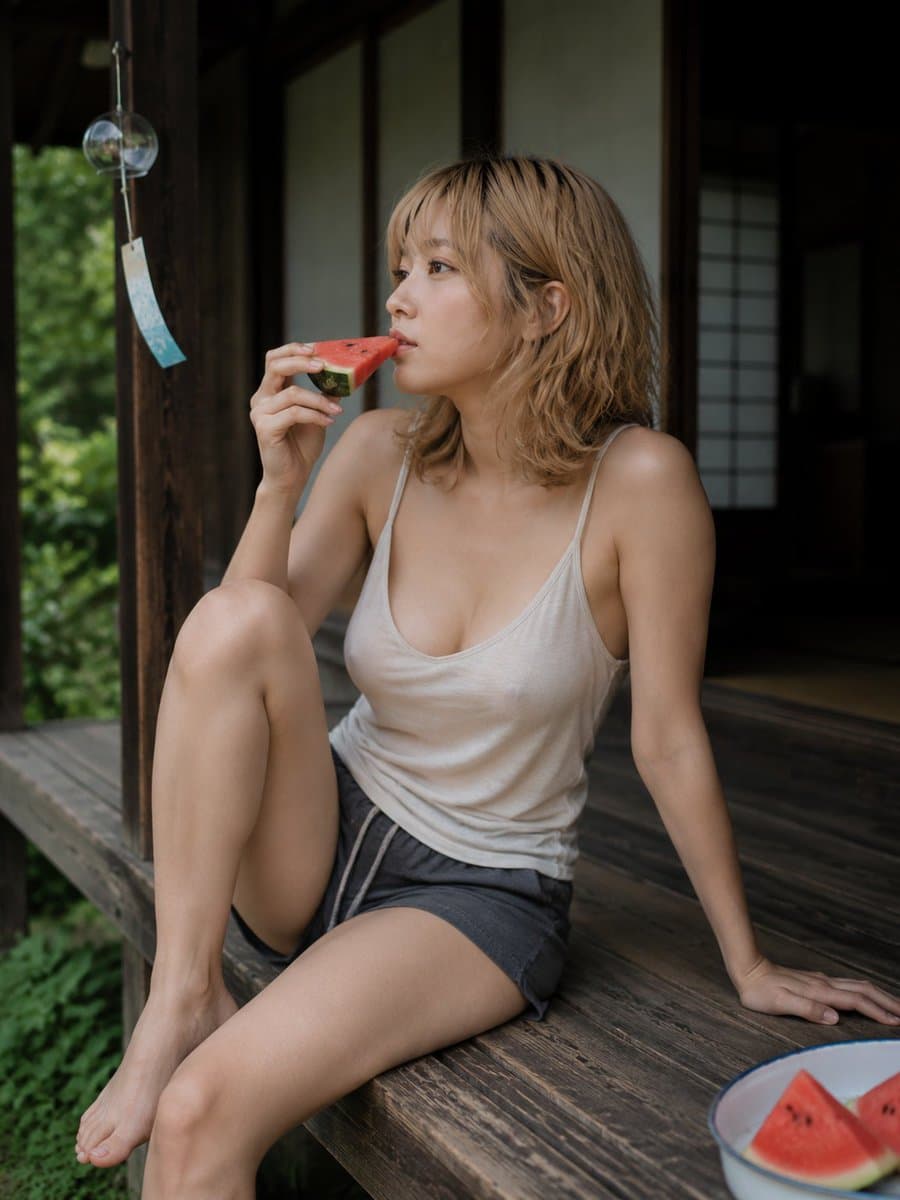
Summer Engawa Portrait
A highly detailed, documentary-style prompt for generating a realistic portrait of a person sitting on the summer engawa of a traditional Japanese home.
Prompt
An unretouched documentary-style photograph of the person from the reference image, shot on a full-frame digital camera with an 85mm prime. Infer and faithfully preserve apparent age, gender presentation, ancestry, face, hair, skin tone and texture, body shape and lines, height impression, proportions, and every physical characteristic exclusively from the reference; never beautify, age-shift, reshape, or invent traits. This applies to the torso in full: chest and bust size, shape and position, shoulder width, rib cage, waist, hips and limb thickness all come from the reference exactly as they appear there. Do not enlarge, reduce, lift, round, or otherwise alter the chest, and do not slim, lengthen or idealize any part of the body. Use the softened neckline and the fitted shorts only when the reference unambiguously depicts an adult; otherwise use a camisole whose neckline still sits at the collarbone and a straight-cut mid-thigh short with the same colors and mood. In either case the shorts stay fully opaque with no underwear visible. Scene: the wooden engawa veranda of an old Japanese house in late July, seen from the garden. Weathered dark timber posts and a run of paper shoji screens fill the background, an open doorway showing a dim room beyond. A small glass wind chime with a paper strip hangs from the eaves into the upper-left corner of the frame, at about head height beside the subject. The rim of a white enamel tray with cut watermelon enters the lower-right corner on the boards. Summer greenery presses in at the left edge. The boards are worn unevenly, with real grain and scuffs. Pose: the subject sits on the edge of the raised veranda in clean side profile to the camera, the front of the body facing out across the garden. One knee is drawn up with that bare foot resting on the boards; the other leg extends down off the veranda. The subject holds a wedge of watermelon in one hand and brings it to the mouth from the side of the face, that elbow resting near the raised knee; the other arm reaches back and the palm presses flat on the boards behind the hip, so the torso stays upright and open and nothing crosses in front of the chest. The gaze goes out across the garden, away from the camera; the expression is languid and unposed, caught mid-bite rather than held for the shot. Outfit: a much-loved everyday camisole in sand-ivory cotton jersey, clearly old and washed many times: the knit has gone soft and slightly limp, the bound neckline has lost its original tension and now sits a little lower and looser than it was made to, and the thin straps have stretched with wear so they sit slack rather than taut, though both stay properly on the shoulders. The color has faded unevenly, the hem curls slightly, and the fabric carries the settled creases of a garment worn at home all summer. It remains fully opaque, unstructured and unpadded, with no shaping or support built into it, so it simply follows the reference body. Slate-gray cotton-linen shorts, equally well-worn and soft, cut close to the body with the hem ending high on the thigh, a relaxed drawstring left untied, and light creases from sitting. Hero visual: every vertical in the frame holds perfectly still — the timber posts, the shoji rails, the hanging cord of the wind chime — and the paper strip beneath the chime is the single element in the photograph caught mid-swing, hanging just off plumb. Camera and framing: a medium shot taken from the garden at roughly seated shoulder height, level with no tilt, positioned square to the subject's profile. The frame runs from just above the head down to mid-thigh: the whole face, both shoulders, the full torso, the waist, the seated hip and the top half of the thighs all read clearly and fill the frame. Crop below the knee; the lower legs and feet stay out of shot. Never position the camera behind the subject; the front of the torso and the profile of the face must both read. Never frame between the legs. Lighting: available light only, overcast-bright midday summer. Soft even daylight from the open garden, the veranda interior falling into deep natural shade behind the subject, cool green reflected fill on the skin from the grass, a slight warm return off the timber. No studio light, no rim light, no artificial fill. Photographic realism: real optical behavior throughout — moderate depth of field around f/2.8 with the background shoji and greenery gently soft, focus on the face, mild lens vignetting, faint chromatic fringing on the brightest highlights, natural sensor grain in the shadowed interior, slightly clipped specular highlights on the glass chime and the enamel tray. No skin smoothing, no airbrushing, no retouching of any kind. Fabric drapes under real gravity with genuine creases. Cotton jersey behaves like real worn knit: soft folds, no crispness, no stiff structure. Format: 3:4 vertical. A candid photograph, not a render or an illustration — no CGI look, no plastic skin, no HDR glow, no digital sharpening halos, no beauty filter.