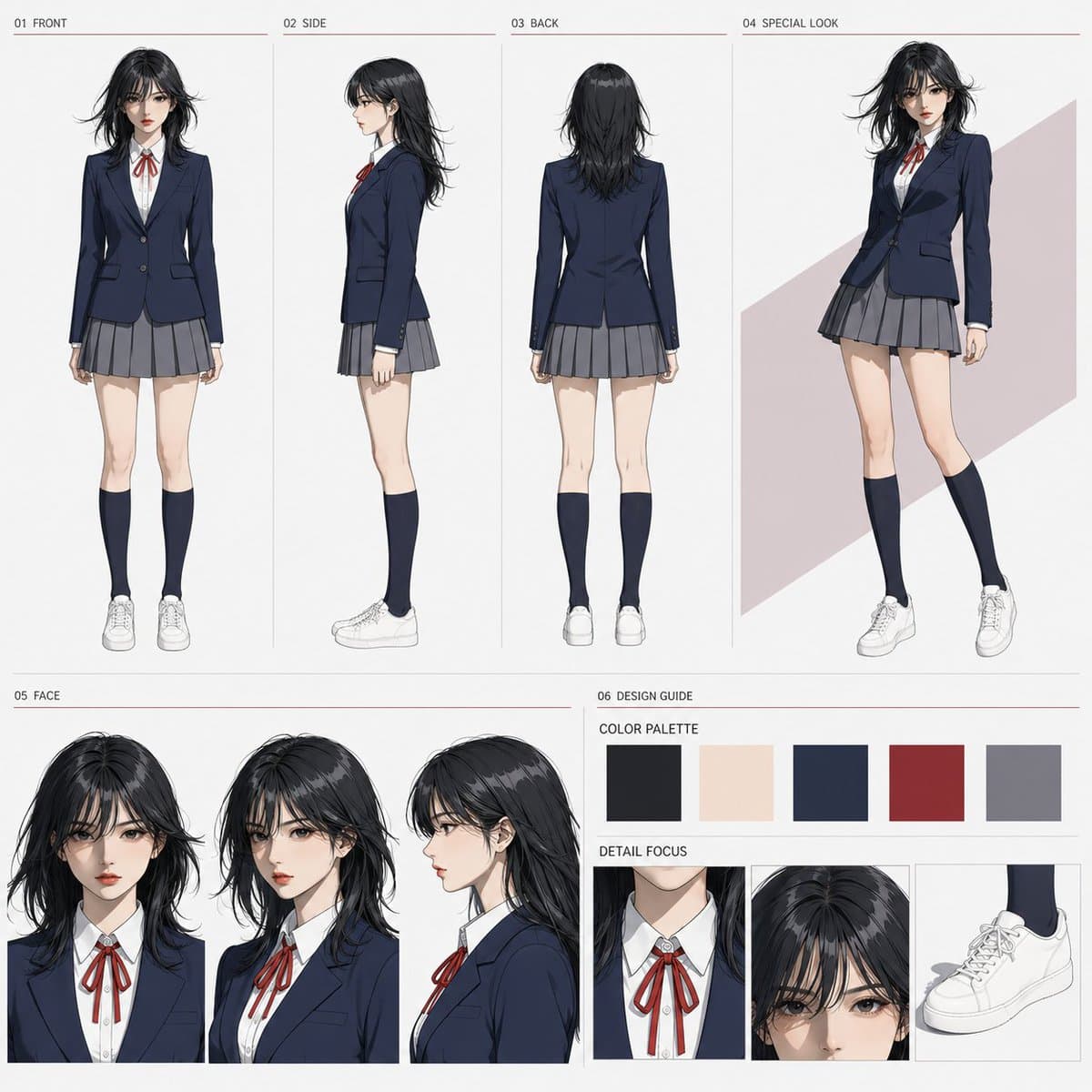
A comprehensive prompt for creating a standardized 2D anime character sheet from a reference image, including front, side, and back views plus design guidelines.
View original source ↗
Prompt · Original / Translation
Use reference:
{argument name="reference image" default="one full-body reference image attached together with this instruction sheet"}
Supports either a live-action person or an illustrated person.
Main text:
Use the single attached full-body reference image as the only person reference, and create one simple 1:1 square character sheet for sharing and video reference. Make it visually polished enough to be published as a standalone image, while also serving as a person-locking sheet where the reference person’s face, hair, age impression, body type, uniform, and color scheme can be checked. Do not include different people, and maintain all person depictions as the same person as the reference subject. Do not make it a storyboard.
[Scope of Reference Image Application]
For a live-action reference, convert it into a high-quality theatrical anime style while preserving the reference person’s traits. For an anime or illustration reference, finish it in a high-quality theatrical anime style while preserving the reference person’s traits. Inherit the facial features, eyes, facial outline, bangs, hairstyle, hair color, age impression, skin impression, body type, head-to-body ratio, and full-body proportions from the reference image. Preserve whether the hair is tied or down, the tie position, parting, hair length, and locks around the face exactly as in the reference image. Do not inherit the outfit, shoes, accessories, props, outfit color scheme, background, or pose from the reference image. Do not leave the reference outfit’s shape, material, decorations, or shoes in the finished image; change them completely into the uniform specified in this instruction sheet.
Use a full-body reference image where the subject can be checked from the top of the head to the toes, and most of the body is not hidden.
[Body Type Lock]
Preserve the reference image’s head-to-body ratio, head size, neck length, shoulder width, ribcage, torso length, hip position and width, arm and leg length, knee position, thigh-to-lower-leg ratio, slenderness and body volume, and full-body silhouette. Limit anime conversion to changes in line, color, shading, and texture; do not redesign the skeleton, body dimensions, or body proportions. Do not make the face smaller, legs longer, torso shorter, shoulder width or hip position different, waist more emphasized, chest or hips exaggerated, body slimmer, body childlike, or changed to a different model body type.
In all of 01 FRONT, 02 SIDE, 03 BACK, and 04 SPECIAL LOOK, maintain the same head-to-body ratio, skeleton, body proportions, and body volume. Draw the full-body displays with standard natural perspective and the same viewpoint height. Do not use wide-angle perspective, strong perspective exaggeration, extreme high angle, or extreme low angle.
[Expression]
High-quality theatrical anime style. Make it bright, clean, organized, and refined, so the character’s appeal comes through even as a standalone image for sharing. Do not make it look like cheap TV anime, mass-produced NPC art, game standing art, 3D CG, or a simple filter applied to a live-action photo.
[Specified Outfit]
Regardless of the outfit in the reference image, change it to {argument name="uniform style" default="navy blazer, white shirt, thin red ribbon, gray pleated skirt, dark knee-length socks, and white-based sneakers"}.
In all four full-body displays, 01 FRONT, 02 SIDE, 03 BACK, and 04 SPECIAL LOOK, maintain the same uniform, same color scheme, same length, and same shoes.
04 SPECIAL LOOK must not be an outfit change; make it a full-body 3/4 view wearing the same uniform.
The blazer, white shirt, and red ribbon visible in 05 FACE must also have the same design and color scheme as in the full-body displays.
Do not let the outfit change the reference person’s body type or full-body proportions. Do not include a school emblem, brand logo, excessive frills, or idol-costume-style decorations.
[Fixed Layout]
The whole sheet should be a two-tier layout: upper tier 58%, lower tier 42%. The background is plain white to very light gray. Ensure enough margins so the character and each element do not overlap. Do not change the basic tier structure, placement, order, or proportions.
[Upper Tier: About 58%]
Divide the upper tier horizontally into four sections using the following proportions.
01 FRONT: 22%
02 SIDE: 22%
03 BACK: 22%
04 SPECIAL LOOK: 34%
01 FRONT, 02 SIDE, and 03 BACK must be full-body displays with the entire body visible from the top of the head to the toes.
01 FRONT is a full-body front view seen straight from the front; 02 SIDE is an accurate 90-degree side view; 03 BACK is a full-body back view seen directly from behind.
Align 01-03 with the same apparent height, head-to-body ratio, body type, outfit, camera distance, and viewpoint height. Use a natural upright posture, with both arms lowered at the sides so they do not hide the body type or uniform.
04 SPECIAL LOOK is a full-body 3/4 view larger than 01-03. The character wears the same uniform, with a still pose that has light movement and a natural expression, conveying the character’s appeal for sharing. Do not make it a story action such as running, jumping, or fighting.
Only behind 04, you may place a simple refined flat color or modest geometric color field using a light accent color chosen from the specified uniform’s color palette. Do not include scenery, buildings, interiors, roads, story scenes, or time progression.
[Lower Tier: About 42%]
Divide the lower tier into 05 FACE on the left 62% and 06 DESIGN GUIDE on the right 38%.
[05 FACE]
Place three face views, front, diagonal 3/4, and side, in a horizontal row at the same size. Align all three with the same camera distance, same face size, and same head position. Use natural neutral expressions that make it easy to check the facial features, eyes, facial outline, bangs, hairstyle, hair color, and age impression. These are not expression variants; they are views for checking the same person’s face and hairstyle from three directions.
[06 DESIGN GUIDE]
Make the upper 40% COLOR PALETTE and the lower 60% DETAIL FOCUS.
In COLOR PALETTE, arrange the five main colors based on the reference person and the specified uniform as neat color swatches: hair color, skin color, navy blazer, red ribbon, and gray skirt. Do not bring colors from the reference image’s outfit or props into the color palette. Show the white shirt and white sneakers inside DETAIL FOCUS.
DETAIL FOCUS consists of three equal-sized sections.
Left: white shirt collar and red ribbon
Center: bangs and hairline
Right: white-based sneakers
All should be based on the specified uniform and character design, and should not recreate the reference image’s outfit, shoes, or accessories.
[Headings]
Use only the following short English headings.
01 FRONT
02 SIDE
03 BACK
04 SPECIAL LOOK
05 FACE
06 DESIGN GUIDE
COLOR PALETTE
DETAIL FOCUS
Place each heading at the upper left of its corresponding area in a small, consistent typeface and size. Do not overlap headings with the character’s face, hair, body, or outfit. The headings and thin divider lines may use a restrained accent color matched to the red ribbon of the specified uniform.
[Prohibitions]
Do not add any person displays other than the specified four full-body displays, three face displays, and three DETAIL FOCUS close-up parts. Do not leave the reference image’s outfit, shoes, accessories, props, or outfit color scheme in the finished image. Do not change the person’s face, hairstyle, body type, head-to-body ratio, or uniform between displays. Do not include backgrounds, scenes, or events unnecessary for locking the person. Do not include thick frames, excessive decoration, long explanatory text, dialogue, subtitles, logos, or watermarks.Reusable method
Reusable structure
Extract “target result → the subject, scene, material, and color palette → constraints” as a reusable template for similar work.
Retest criteria
Run single-variable comparisons around subject description, style intensity, lighting, and material constraints. Record the model, cost, and failures; turn it into a Skill only after it repeats reliably.
Recommended models
Derived Skill
Skills are derived from repeated patterns in published cases. They are not a separate submission type.

Creator
AIライフハック focuses on AI video production and is active on X. “Island Miniature Model Harbor City Montage” is the current representative case, built with Seedance 2.0 awaiting a stability retest.
Keep exploring

A detailed 3D CG render depicting an oriental fantasy girl with long mint-green hair, using high-quality PBR materials, with a dreamy garden background.
Prompt
9:16 vertical format, high-precision 3D CG oriental fantasy sweet-cool girl character poster, 3D CG oriental fantasy girl character portrait, anime-style 3D CG character art, semi-realistic 3D character render, full body portrait. The main subject is a clearly adult young female oriental fantasy character, with a visual age of about 20–24. Her overall temperament is sweet, light, energetic, dreamy, and carries a slightly impish elf-like cuteness. The overall image is not a flat illustration, but a highly finished 3D CG character render, with refined character modeling, realistic material expression, translucent colors, soft light and shadow, and a premium virtual character poster quality. The character has a refined, sweet, oriental beautiful face, a small oval face, and fair, delicate skin with slight translucency and soft skin shading. Her eyes are large and bright, with irises mixing pink-purple and light rose-purple. The pupils have delicate glass highlights, and her gaze is gentle, lively, and slightly playful and approachable. Her eyelashes are long, her eye makeup is clear and natural, her nose bridge is elegant and small, her lips are soft, and her lip color is a low-saturation sakura pink. Her expression is relaxed and cute, with a faint smile at the corners of her mouth. The hairstyle is long mint blue-green hair. The strands are full and smooth, with high-precision hair-strand modeling and a soft, bright sheen. The long hair falls naturally to the waist, with a slight curl and airy feel at the ends. There are light wispy bangs in front, and soft side locks on both sides frame the face. The character has delicate light-colored small horns, pointed ears, and a slender tail, enhancing the oriental fantasy elf / little-demon temperament. She wears a purple bow headpiece and small fantasy ornaments on her head, with refined and consistent details. The outfit preserves the sweet-cool modern feel of the original image and is adjusted into a more refined 3D CG oriental fantasy everyday look: the upper body wears a light pink cropped hoodie, with pale purple cuffs, purple bow drawstrings, and a semi-transparent heart decoration on the chest. The fabric is soft and fluffy, with realistic textile texture; The lower body wears light blue ultra-low-rise denim shorts. The cut is changed to a more form-fitting, tighter wraparound design. The denim fabric tightly fits the waist, hips, and upper thighs, and the waistband, leg openings, and hip-crotch connection areas should show fairly obvious flesh indentation and compression. The edges of the shorts slightly sink into the skin, creating natural soft fleshy rises and contours. In particular, the waist sides, hips, and upper-thigh areas should have a clear tightness and stress effect, conveying realistic tight denim material behavior rather than a loose, flat outline. It should both emphasize a slender waistline and show the realistic wrapping of close-fitting shorts around the hips and upper legs. The legs are paired with white slouch socks or soft long socks, with purple bows decorating the sock openings and shoe uppers. One thigh wears a purple thigh-ring accessory. The thigh ring needs to be visibly tightened, pressing into the thigh skin and creating relatively clear flesh indentation and soft pressure marks. There should be natural slight bulging layers of flesh above and below the thigh ring, while still remaining beautiful, delicate, and realistic, not stiff. She wears light, sweet fantasy-style shoes in white and pale purple. The overall styling is sweet, fresh, and playful, while also having a slight oriental fantasy idol feel. The character pose is a natural standing pose or slight walking pose, with one leg slightly forward, the body gently turned sideways, and both hands naturally hanging down or moving slightly. The overall posture is light and lively, with a bit of girl-idol-style friendliness. The character’s full-body proportions are long and balanced, with a slim but natural figure and a youthful, energetic feel. Remove the rings and music notes from the original image. Do not use pure flat background decorations, do not use floating music notes, and do not use geometric rings. Change the background to a dreamy oriental fantasy scene that matches the character’s temperament: a garden courtyard / elf greenhouse / fantasy corridor surrounded by cherry blossoms and hydrangeas in soft pink-purple and mint tones. The scene may include white jade railings, light flower vines, pale stone paths, dreamy flower clusters, floating glimmers, thin mist, and faintly visible distant pavilions or glass greenhouse structures. The overall setting should feel like a sweet and refined oriental fantasy secret realm. The background should be bright, clean, and translucent, with soft layering and a premium sense of space, matching the character’s cute, gentle, dreamy temperament. Lighting uses soft, bright, high-key dreamy illumination. The face is clear and translucent, with delicate highlights on the hair strands, shoulders, skirt-edge areas, and sock folds. The skin, hair, fabric, denim material, bows, shoe uppers, and fantasy accessories all have realistic and clear PBR material expression. The overall palette is mainly light pink, mint green, pale purple, milky white, and light blue. The image is sweet, refined, fresh, and dreamy, with the feeling of a high-end collectible 3D CG oriental fantasy girl character poster. high detail 3D CG render, Unreal Engine quality, Octane render look, cinematic soft lighting, PBR materials, subsurface scattering skin, realistic hair strands, pastel fantasy garden background, elegant oriental fantasy vibe, mint green long hair, small horns, elf ears, cute tail, pink cropped hoodie, denim shorts, white leg warmers, purple bows, dreamy atmosphere, volumetric light, cinematic depth of field, soft bloom, ultra detailed, polished anime realism, premium virtual character portrait negative prompt: circle halo, ring background, music note, floating music symbols, flat background, plain pink backdrop, text, watermark, logo, low quality, blurry, bad anatomy, extra fingers, fused fingers, deformed face, stiff pose, plastic skin, cluttered composition

Generate a luxurious anime fantasy-style playing card featuring an elegant gothic lolita girl, with ornate gold filigree, ruby decorations, and casino-themed details.
Prompt
Goal: Create an ornate vertical fantasy playing card illustration for the {argument name="card rank and suit" default="8 of diamonds"}, featuring a glamorous anime girl as the central character. Canvas: Tall portrait playing-card format with rounded cream corners, a thin dark outer stroke, and an elaborate antique gold filigree border. Use a symmetrical card composition with the rank and suit repeated in exactly 2 corners: top-left shows a large red “8” above a red diamond pip, and bottom-right shows a large red diamond pip above a red “8”. Central subject: A beautiful young anime woman seated diagonally in a luxurious pose, one knee raised in the foreground and one hand resting near her lips. She has {argument name="hair color" default="long ash-brown hair with soft waves"}, warm brown eyes, delicate facial features, glossy skin highlights, and a calm slightly wistful expression. Her hair flows across the card and is decorated with a large deep-red patterned bow, jeweled hair ornaments, and small gold accents. Outfit and accessories: Dress her in a highly detailed gothic-lolita casino-inspired gown using {argument name="main color palette" default="black, burgundy red, antique gold, cream, and jewel ruby"}. The outfit includes exactly 6 prominent outfit/accessory groups: 1 black-and-gold embroidered corset bodice with red heart jewel accents, 1 layered burgundy-and-black ruffled skirt, 2 translucent lace puff sleeves, 1 ornate choker and necklace cluster, 1 pair of dangling diamond-shaped earrings, and 1 decorative thigh garter with gold chains and rose charms. Add many fine gold chains, lace trim, filigree embroidery, tiny beads, ruby gems, and heart motifs. Background and playing-card details: Behind her, create a dark midnight casino-fantasy background with hanging gold chains, sparkling dust, red gem fragments, and an antique clock face in the upper-right background. Include exactly 5 small floating playing cards around her: 2 on the left side, 1 near the upper-left behind her head, and 2 on the right side. The floating cards should have ornate patterned backs, tilted at different angles, with no readable numbers. Add exactly 4 visible rose clusters integrated into the border: one large cluster at upper-right, one vertical cluster along the right edge, one cluster at lower-left corner, and one small rose accent near the raised leg. Visual style: Ultra-detailed Japanese anime illustration, elegant shoujo fantasy, luxury tarot-card aesthetics, intricate linework, luminous highlights, warm rim lighting, high contrast between dark background and glowing gold ornamentation, ruby-red accents, painterly polish, delicate sparkle effects, romantic and lavish mood. Constraints: Keep the composition framed like a single collectible playing card, not a poster. Preserve the exact rank-and-suit corner layout for the {argument name="card rank and suit" default="8 of diamonds"}. Avoid extra text, logos, watermarks, cropped borders, modern UI elements, or photorealism.

A comprehensive system prompt designed to create a high-quality, highly consistent character sheet, including multi-angle views, facial details, and architectural environment references.
Prompt
【Input Items】 Outfit type: [{argument name="Outfit type" default="Business / polished date outfit"}] Color direction: [{argument name="Color direction" default="Navy / red"}] If left blank, use “Business” and “Navy.” 【Reference Used】 One full-body reference image attached together with this instruction sheet. 【Main Text】 Use the one attached full-body reference image as the only character reference, and create one high-quality photorealistic character sheet in a 1:1 square format. If the reference image is photorealistic, maintain the same person. If it is a character illustration, convert it into a natural photorealistic person while preserving the character traits. Preserve the referenced person’s facial features, hairstyle, hair color, age impression, skin tone, gender impression, apparent height, head-to-body ratio, body type, and full-body proportions. Do not beautify, make younger, make older, change the body type, or turn them into a different person. In principle, only the outfit and shoes should be changed. 【Outfit】 Naturally adapt the specified outfit type to the referenced person’s gender, age impression, and body type. ・Business A modern, clean business style. Include a jacket, and make it neat, practical outdoor clothing. ・Polished date outfit Elegant, slightly glamorous outdoor clothing suitable for a date at a restaurant or in the city. The outfit should make the full body shape easy to see. Avoid uniforms, overly formal attire, excessively long hems, large decorations, complex layering, and brand logos. 【Color Scheme】 Use the specified color as the main color or central color of the outfit. A small number of auxiliary colors such as white, ivory, gray, and black may be added, but do not make it multicolored. ・Navy: centered on deep navy ・Red: centered on deep red, bordeaux, or wine red 【Overall Layout】 Use a two-tier composition, with the upper tier occupying about 58% and the lower tier about 42%. Do not change the basic placement, order, or proportions. 【Upper Tier: About 58%】 01 FRONT: 22% 02 SIDE: 22% 03 BACK: 22% 04 SPECIAL LOOK: 34% 01–03 should be full-body views at the same scale, fully showing the figure from the top of the head to the toes. Keep apparent height, head-to-body ratio, body type, outfit, shoes, and camera distance consistent. Use a natural upright posture, and do not let the arms or hands hide the body type or outfit. ・01 FRONT: front full body ・02 SIDE: full body from exact side view ・03 BACK: back full body 【04 SPECIAL LOOK】 A larger full-body 3/4 view of the same person in the same outfit as 01–03. Use a still pose with light movement and a natural expression that best conveys the character’s appeal. Only behind 04, a simple flat color or restrained geometric color plane using the specified color lightly may be placed. 【Lower Tier: About 42%】 Use the left 62% for 05 FACE and the right 38% for 06 BUILDING REFERENCE. 【05 FACE】 Arrange three face views, front, diagonal 3/4, and side, in a horizontal row with the same size, same camera distance, and same head position. All three should have natural normal expressions and make the facial features, eyes, contours, bangs, hairstyle, and age impression easy to confirm. 【06 BUILDING REFERENCE】 Use the entire 06 area as one wide-angle exterior image where the building front, entrance, and outdoor plaza structure can be confirmed in a single composition. Do not reflect the outfit type or color direction in 06. Make it a neutral building reference, unaffected by the person’s outfit color, the theme color of 04, or the accent colors of the overall sheet. Depict a clean, modern building front and automatic glass entrance as seen from a broad outdoor plaza, under bright, even natural daylight. Do not add night scenes, sunset scenes, warm lighting, illumination, strong color-tone effects, or staging that strongly suggests a specific use such as a hotel, restaurant, or office. Do not subdivide the inside of 06 either; compose it as one single image from one single viewpoint. Do not create a collage, multiple views, vertical splits, or paired angles. Compose it with one continuous exterior wall, one ground floor, one continuous ground surface, one building front, and one clearly defined entrance. Clearly depict either a left-right sliding automatic glass entrance or a revolving automatic glass entrance, and do not mix different entrance structures. Use the lower about 30–40% of the 06 area as a continuous outdoor plaza, and the upper about 60–70% as the building front. Place the entrance only once at the lower center, with the entrance width around 20–30% of the entire 06 area as a guide. Use a wide-angle composition where the straight path toward the entrance is clear and the proportions of the building, ground, and entrance look natural. Do not include a close-up display of only the entrance, an overly distant full view where the entrance cannot be identified, multiple entrances, vertically duplicated building fronts, double ground surfaces, complex stairs or terraces, people, cars, or signs. 【Headings】 Use only the following short English labels. 01 FRONT 02 SIDE 03 BACK 04 SPECIAL LOOK 05 FACE 06 BUILDING REFERENCE Place each heading at the upper left of its corresponding area, in a small, unified typeface, without overlapping important parts of the person or building. The specified color may be used subtly for the headings and thin dividing lines. 【Common Design】 Except for 06 BUILDING REFERENCE, the sheet background should be white to very light gray. Ensure sufficient margins so the person and each area do not overlap, and create an organized, refined design that can be shared as a standalone image. The character display should include only the specified four full-body views and three face views, and all should maintain the same person and same outfit as the reference image. Do not include thick frames, excessive decoration, long explanatory text, dialogue, subtitles, logos, brand names, or watermarks.